 noteboard
1. Write the question your piece will explore
Start with a sentence about the piece. For an essay, say what you're trying to understand and why it might interest a reader. For fiction, write who the story follows, what they want, and what makes it difficult. You can revise this sentence when the material changes your mind.
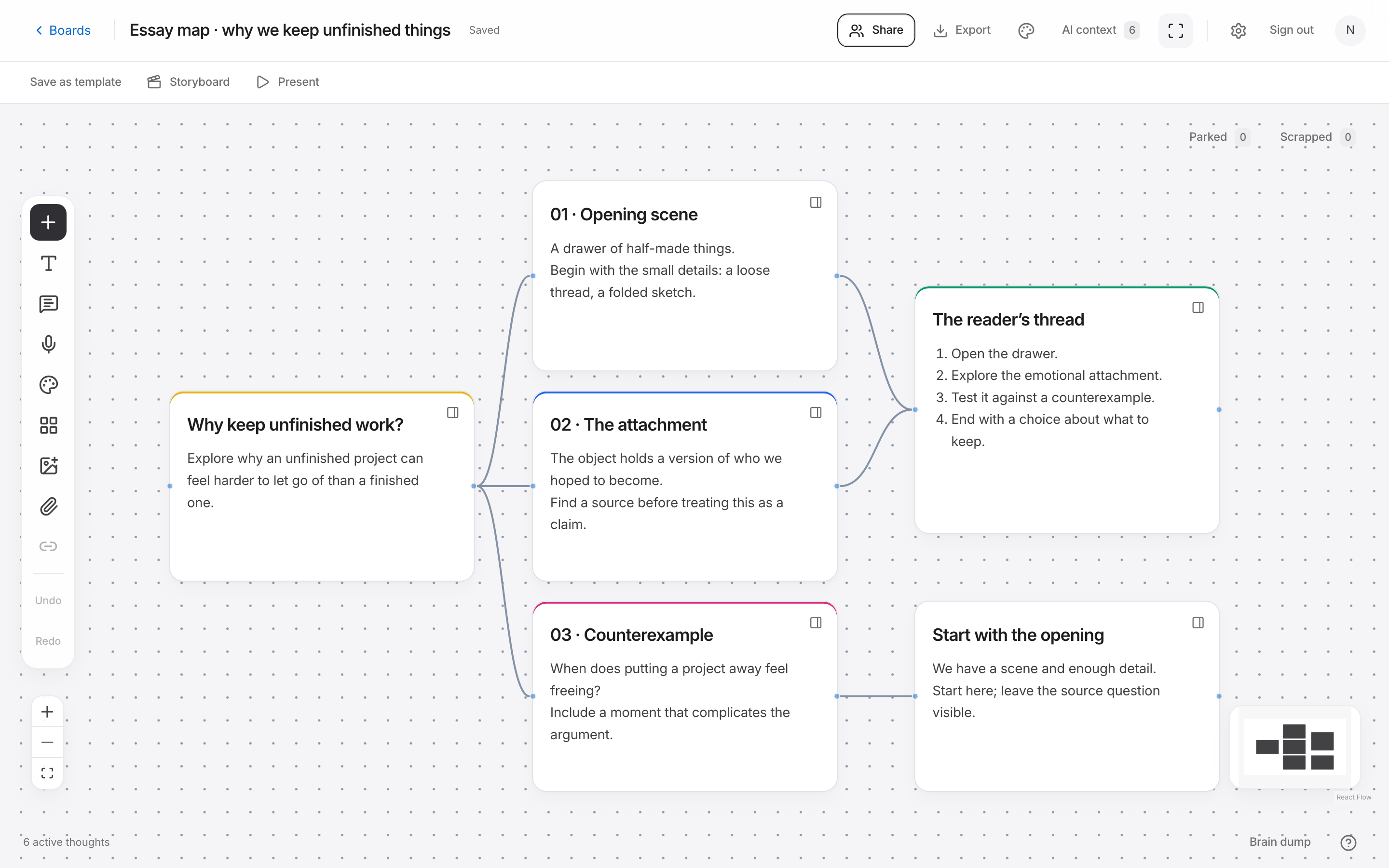
Our example is a personal essay about unfinished projects. The starting question is: “Why do I keep objects for hobbies I no longer do?” That's narrow enough to explore through a few scenes and observations. It also leaves room for an answer that is more complicated than the first guess.
Keep that question visible on the board. When an interesting tangent appears, ask how it connects. Save it elsewhere if you can't explain the connection yet. You can return to it without letting it take over the piece you're trying to write.
2. Capture scenes, claims, and sources as separate notes
Write down the material you already have without worrying about the opening. Give each scene, observation, argument, or research question its own card. A writing mind map is easier to rearrange when the notes can move independently.
For the essay, one card describes a drawer of abandoned craft supplies. Another describes a nearly empty sketchbook. A third asks whether the objects represent an activity you still want to do or an old idea of yourself. These are possible directions to explore, not conclusions you've proved.
Keep research beside the claim it might support, including enough source detail to check it later. Mark an unsourced explanation as a question. If an idea arrives while you're away from the desk, capture a voice note and review the transcript before adding it to the board.
3. Arrange the material into a thread a reader can follow
Group notes that belong together, then look for an order. What does the reader need to know before the next scene or claim will make sense? Which example gives you a useful opening? Which question keeps the piece moving? You can try two different sequences without drafting both versions.
In the essay, the drawer gives the reader something concrete to picture. The next section can explore why the objects stayed. A counterexample—a project you returned to and enjoyed—complicates the idea that unfinished things should simply be discarded. The ending can then explain what you chose to keep and why.
Draw a connection wherever one section depends on another. A gap between cards may show that you need a transition, an explanation, or a source. If you use AI, select the outline and ask where a reader would need more context. Treat its suggestions as possibilities to review in your own voice.
4. Draft the section with enough material to begin
Choose a section that has a clear point and enough detail to write. It can be the opening, but it doesn't have to be. Mark the section on the map, move distracting alternatives aside, and draft in the writing tool you prefer.
For the drawer scene, you might begin with a few physical details rather than explaining the whole argument. An illustrative opening could be: “Behind the spare cables was a box of paints, still wrapped in the receipt from the shop.” The specific object gives you something to describe and something to ask about.
Return to the map when the draft changes. You may discover that a scene does more work than expected or that the proposed ending no longer fits. Update the outline to reflect what you've written, rather than forcing the draft to follow an arrangement that stopped being useful.
Example: turn an essay mind map into an outline
The map holds several possible explanations at once. The outline chooses a reading order. Here is one way to use the essay material above; another writer could choose a different sequence from the same notes.
Read the outline aloud as a short account of the piece. If the movement from one section to another is hard to explain, go back to the map and look for the missing connection. This is a useful check before spending hours polishing individual paragraphs.
| Outline section | What it does | Material from the map |
|---|---|---|
| Open with the drawer | Introduce the question through a scene | Paints, receipt, and other unused supplies |
| Explore why the objects stayed | Develop two possible explanations | Notes about habit and an imagined future project; research questions to check |
| Consider a counterexample | Test the first explanation | A sketchbook that was eventually used again |
| End with a specific choice | Show what changed in the writer's thinking | Which objects were kept, used, or given away, and why |
Using the same method for creative writing brainstorming
For fiction, replace argument branches with a character's goal, obstacles, choices, and consequences. Put each possible scene on a separate card. Connect the scene to what it changes: a decision, a relationship, or the information the reader has.
Suppose a character returns to an old studio to collect their belongings. A locked cupboard, a note from a former collaborator, and a half-finished piece could each lead the story somewhere different. Choose the sequence that develops the conflict you want to explore. Save the unused scenes so you can reconsider them later.
An AI prompt for this workflow
Challenge the selected outline. Where would a reader need more context, and what alternative structure could make the main idea clearer?
Can I use the same method for fiction and nonfiction?
Yes. Both benefit from separate cards and visible relationships. Fiction may organize scenes and character choices; nonfiction may organize questions, claims, and supporting sources.
Try this in Noteboard.ai
Start with a central question and branches, then add your scenes, claims, and sources. Use the map to decide the order, then write the outline in your preferred writing tool.
Explore AI idea generator