 noteboard
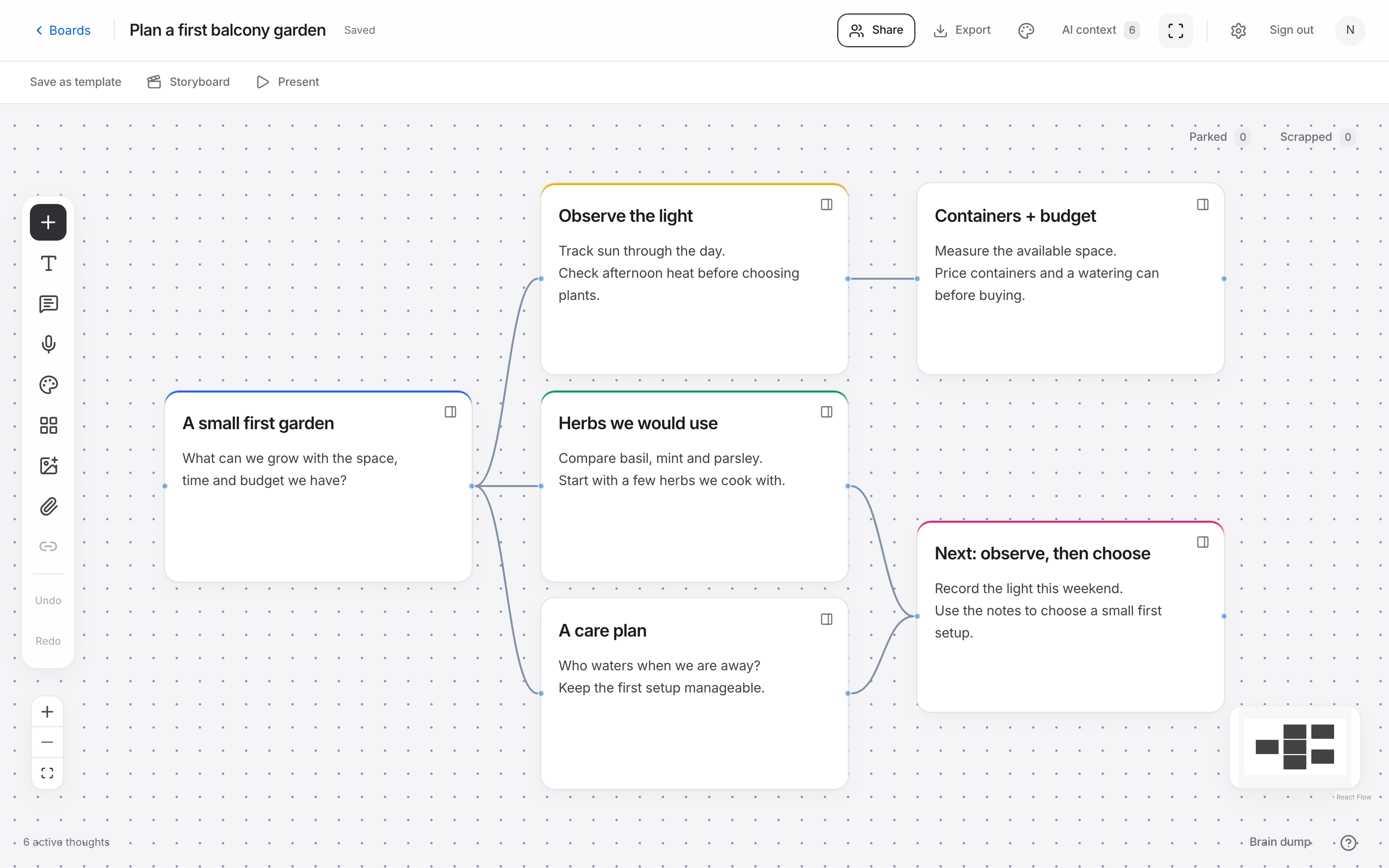
1. Put a specific topic or question in the center
Choose something you can explore in one sitting. “Start a balcony garden” gives you a manageable subject. “Everything about gardening” leaves you with too many possible directions. If you're making a decision, write it as a question: “What can I grow on this balcony with the time and money I have?”
Add that topic to the center of your page or board and leave room around it. You can shorten the label to “Balcony garden” while keeping the full question in the note. The wording can change as you learn more; you don't need the perfect title to begin.
Before adding branches, decide what the map is for. In this example, we want to choose a small first setup. The Noteboard.ai mind-map template starts with a central question and three branches: Possibilities, Constraints, and Questions. Replace those prompts with the balcony-garden topic and adapt the branches as you follow the guide.
2. Add branches for the main parts of the topic
Write the categories that come to mind. For the garden, try sunlight, plants, equipment, budget, and care. You only need a few to begin. If two categories keep collecting the same notes, combine them. If one becomes crowded, split it into smaller groups.
Give each detail its own short note. Under sunlight, write what you've observed. Under plants, list herbs you actually cook with. Under care, add who will water them when you're away. Use a brief title and put longer explanations in the note so you can still scan the map.
A branch can contain a question as well as an answer. “How hot does the balcony get?” is useful because it tells you what to check before choosing plants. Mark it clearly so a guess doesn't look like something you've already confirmed.
Example branches for a first garden
- Plants
- Basil, mint, and parsley: compare what we use, available space, and care needs.
- Equipment and budget
- A few containers and a watering can. Check prices before choosing the first setup.
- Care
- Write down watering arrangements and check how the balcony conditions change during the day.
3. Connect details that affect each other
Start by connecting each detail to its main branch. Then look across the map. The container choices affect the budget. The number of plants affects the watering work. A cross-connection can show why two decisions need to be made together.
If someone else would have to guess what a line means, label it. “Adds to cost” or “needs someone to water it” explains more than an unlabeled connection. You don't have to connect every note to every other note; keep the lines that help explain the project.
In Noteboard.ai, move the notes until the groups are easy to see. Keep a small gap between branches and give related notes a similar position. Use color sparingly, perhaps for unanswered questions. The arrangement should help you read the ideas without needing to remember a complicated color system.
4. Read the map and decide what to do with it
Read one branch at a time. Can you explain what it says in a sentence or two? Look for repeated notes, unsupported assumptions, and questions that stop you from making a choice. Add a missing detail only when it changes your understanding or the decision.
For the garden, the map might show that you need to observe the light before buying anything. Write that action beside the sunlight branch. You can keep other questions open without solving the whole project in this session.
If you use AI, select one branch and ask what you may have missed. Review the response against your own circumstances. A suggestion can point to something to investigate, but it doesn't establish the conditions on your particular balcony.
What to change when a mind map gets crowded
Long labels make a map difficult to scan. Keep the main point in the title and move the explanation into the note. If a branch holds two different subjects, split it. If several cards say the same thing, keep the clearest version and preserve any details you still need.
Stop organizing when the map helps you do the job you started with. A learning map may end with a short explanation in your own words. A planning map may end with a decision and an action. You can return to the map later instead of trying to make it complete today.
An AI prompt for this workflow
Look at this branch. What question am I missing, and which assumption should I check before moving forward?
Does a mind map need a strict tree structure?
No. A central topic and branches are a useful starting point, but a freeform map can include cross-connections when an idea affects more than one part of the project.
Try this in Noteboard.ai
Use the mind-map template for a central question and three starter branches. Add your own notes and adapt the structure as you follow the four steps.
Explore Visual mind mapping