 noteboard
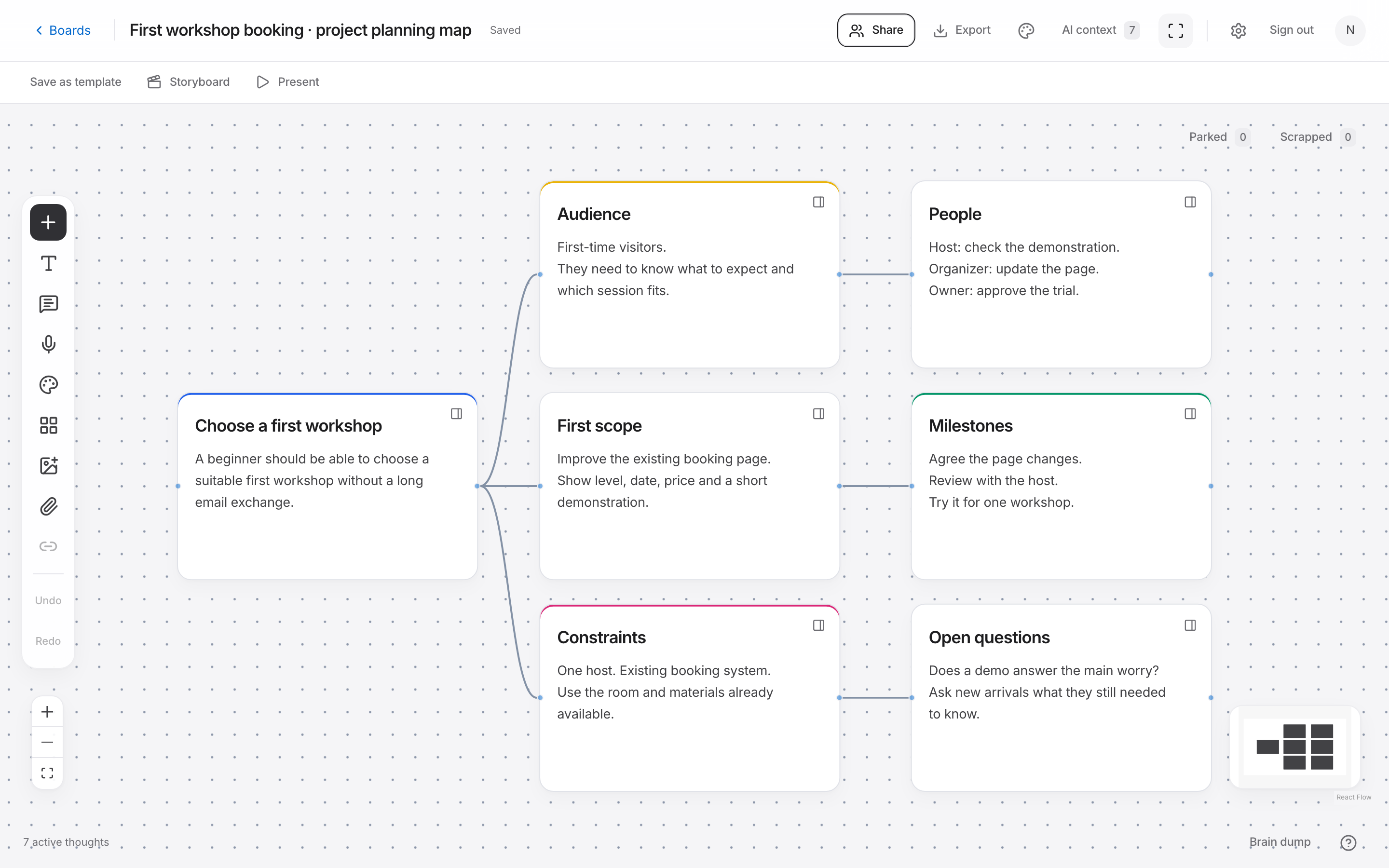
Start with the project goal and six planning branches
Write the result you want at the center. For our example, a studio wants beginners to choose an appropriate first workshop without needing a long email exchange. That leaves several possible approaches open, including changes to the information people already see.
Add the branches below. Treat them as questions to answer, rather than headings that must be filled with lots of notes. A short, specific entry is useful. “One host can support the trial” tells you more than “resources.”
The mind-map template starts with a central question and three branches: Possibilities, Constraints, and Questions. Rename and extend those branches using the planning questions below.
- Audience: who needs this, and what are they trying to do?
- Scope: what result should the first version deliver?
- Constraints: what time, budget, materials, and existing systems must you work with?
- Milestones: what needs to be decided or reviewed before you can continue?
- People: who will do the work, answer a question, or approve a decision?
- Open questions: what could change the plan if the answer is different from your guess?
A worked example: from a problem to a first experiment
A small studio team is considering a tool to help beginners choose a workshop. Before deciding what to build, it maps the problem, compares alternatives, and identifies the assumption each approach depends on. These are fictional planning notes, not research results.
| Stage | Worked example |
|---|---|
| Problem | Beginners email the studio to ask which workshop suits them. |
| Observations | Questions concern experience level, what participants will make, and what they need to bring. |
| Alternatives | Rewrite the descriptions, offer a short choice form, or ask the host to recommend a session manually. |
| Assumptions | Clearer descriptions may answer the questions. A form may help people choose. Some visitors may still need personal advice. |
| Planned experiment | Ask five prospective first-time visitors to choose from draft descriptions. Record where they hesitate and what information they request. |
| Review point | The organizer prepares the drafts, the host checks accuracy, and the team reviews what remains unclear before deciding whether to build a form. |
Connect each proposed solution to the observation it addresses and the assumption it depends on. Keep the alternatives visible while choosing one experiment to run first.
Write down what would change the plan. If clearer descriptions answer the questions, the team may have enough to proceed with a page revision. If visitors still need advice, record the missing information before deciding what a form should ask.
1. Describe the problem in terms of what happens today
Write down who experiences the difficulty and what they do now. “New visitors email to ask which workshop is suitable” describes an observable situation. “We need a recommendation dashboard” skips straight to a particular solution and leaves its purpose unexplained.
Add the evidence you have, such as the questions in those emails. Keep possible explanations separate. Visitors might need advice, or the session descriptions might omit a practical detail. A booking app would be a different response from a clearer description.
Name the question that matters most to the next decision. Here it is: “What information do beginners need to choose?” That gives you a reason to review the enquiries or speak to a few visitors before planning a long list of features.
2. Put more than one approach on the map
Give each possible response its own group. The studio could rewrite the descriptions, offer a short guided choice, or have the host recommend a session manually. Add what each approach would need and which part of the problem it addresses.
Include a simple manual option when you can. It may be enough for a small project, or it may help you understand what an automated version should do. You can learn from the information a host asks for before designing the questions an app would present.
If you use AI, select the problem and evidence notes and ask for alternatives within your actual limits. Review the suggestions for details they assume, such as an account system or data you don't collect. Leave those assumptions visible until you decide whether they belong in the plan.
When working as a team, ask each editor to add an observation or alternative before discussing the options together. Use comments for questions, then put agreed decisions and relevant background into board notes before selecting context for an AI request.
3. Decide what belongs in the first version
Choose a result small enough to try with the people and time available. For the studio, the first version might be two revised session descriptions and a short choice form reviewed by the host. Payments, saved profiles, and automatic reminders can stay outside this trial.
Write both the included work and the boundary. That makes later suggestions easier to discuss: does this help answer the question the trial is for, or does it belong in another round? Keep useful later ideas on the board without silently adding them to today's commitment.
When thinking about how to plan an app, connect each proposed capability to a user need or an experiment. A product mind map can hold several future possibilities while still making the current build small and clear.
Example: choosing the first scope
- We want to learn
- Which details beginners need before choosing a session.
- Include in the trial
- Clearer descriptions and a short form that the host can review manually.
- Keep for later
- Accounts, automated recommendations, and payment integration until there is a reason to include them.
4. Write down what you will try and what would change the plan
Name the uncertain part of the idea. In this example, the studio assumes that a few questions will help a beginner choose. To explore that, show the draft descriptions and form to a small number of suitable visitors and ask them to explain their choice.
Write what you'll observe before the trial. Do they understand who each session is for? Which question needs explaining? What information do they ask for that the draft leaves out? A small exploratory trial can reveal useful problems, but it doesn't establish how every future visitor will behave.
Add an owner, a review point, and a decision you will make afterward. If the descriptions answer the questions on their own, you may not need a form. If visitors still need personal advice, record why before building an automated response.
Give the experiment an owner and a review point. Record the questions you will ask and what you plan to observe before running it. Afterward, separate what happened from your interpretation, then update the affected assumption on the map.
Move the agreed work into a delivery plan
Once the approach is clear enough, turn it into tasks with owners, dates, and dependencies in the project tool you use. Link that plan to the board so people can find the problem statement and the reasoning behind the scope.
Return to the map when a new observation changes a decision. Update the affected branch rather than redrawing the entire project. The map is useful while it helps the team understand what they are doing and why.
An AI prompt for this workflow
Using these observations and constraints, suggest three approaches to the problem. For each, identify the assumption it depends on and a small test we could run. Flag missing information and avoid inventing customer preferences, results, or deadlines.
Is a planning board a replacement for a product roadmap?
A board is useful for exploring the problem and deciding what to test. Use your delivery tools for schedules, dependencies, and task tracking once the direction is clear.
Try this in Noteboard.ai
Use the mind-map template to collect your goal, observations, constraints, and alternatives. Add the assumptions you need to check, then record the test, owner, and review point.
Explore Focused AI context