 noteboard
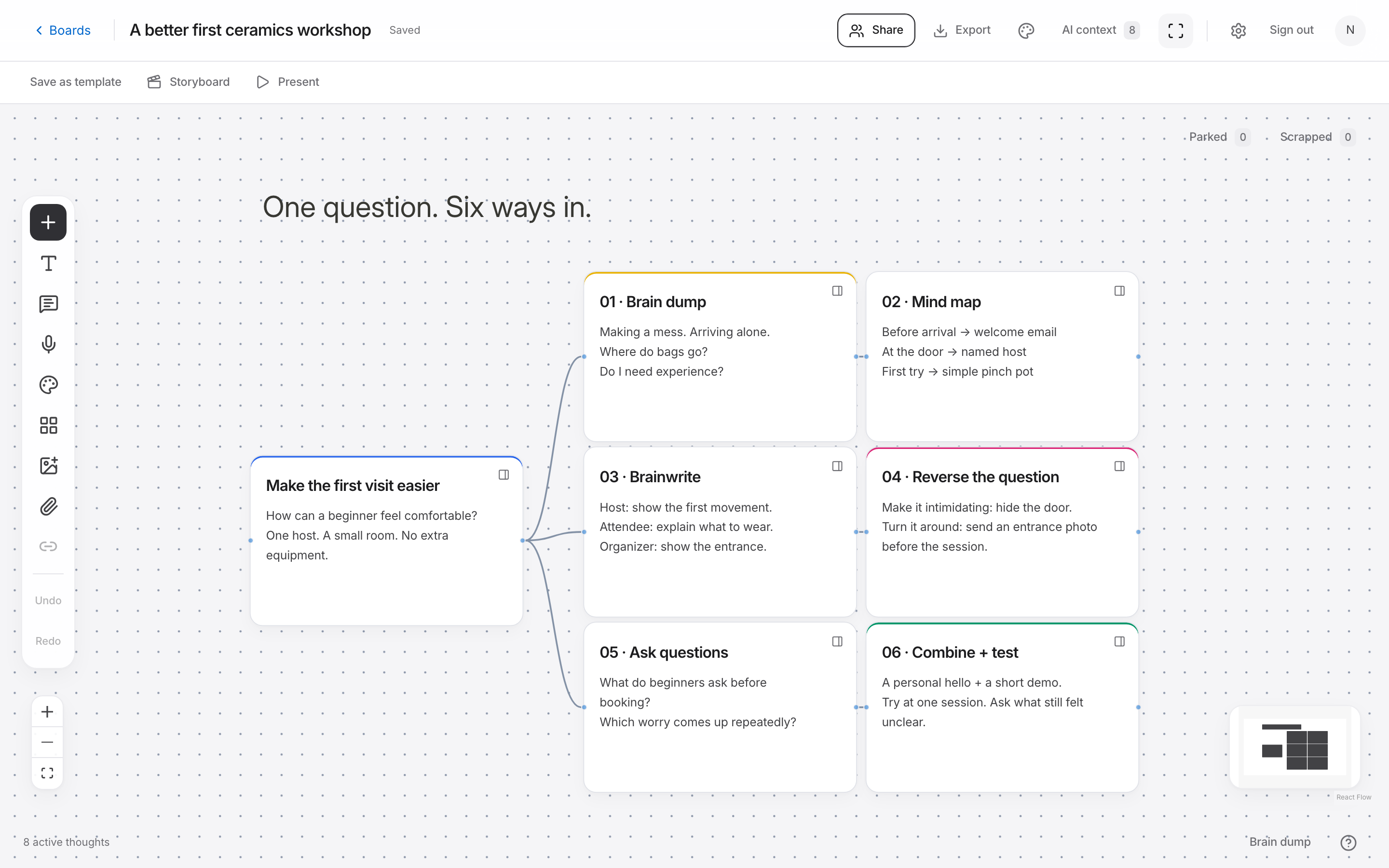
Choose a technique for what is getting you stuck
Start by writing one question you can actually work on. For this guide, we'll use a fictional ceramics studio asking: “How can we make a first workshop less intimidating for beginners?” The studio has one host, a small room, and no budget for extra equipment. Those details give the ideas something to respond to.
Choose one of the methods below and give it a short session. You can try another if you need a different angle. Keep the early ideas visible, even when they seem impractical; you can compare them after you've explored a few possibilities.
| If you are stuck because… | Try this |
|---|---|
| There is too much on your mind | Brain dumping |
| You have ideas but cannot see how they connect | Mind mapping |
| A few people are doing most of the talking | Brainwriting |
| Every suggestion sounds familiar | Reverse brainstorming |
| You are unsure what the real problem is | Question-led brainstorming |
| Two partial ideas each have something useful | Combining ideas |
1. Brain dumping: write everything down first
Set a timer for five minutes. Write down everything that comes to mind about the question, including worries, half-formed suggestions, and things you need to find out. If speaking is easier, record a voice note and review the transcript afterward. Leave the sorting until the timer ends.
The studio's list might include “people worry about making a mess,” “show a finished cup,” “where do bags go?” and “what if someone arrives alone?” Now there are several specific things to explore. Group similar notes, then choose a theme for the rest of the session.
2. Mind mapping: connect the ideas around a question
Put the workshop question in the center. Add branches for the first visit: before arrival, meeting the host, trying the activity, and leaving with something made. Place your notes under the part of the experience they concern. Add a branch when a note doesn't fit the existing groups.
Connect “arrives alone” to “meeting the host.” That might suggest a named welcome or a small activity people can start together. The useful part is seeing how a concern relates to a possible response. Keep adding details where they help you understand the problem.
3. Brainwriting: let people write before discussing
Give everyone the same question and a few quiet minutes to write separately. Ask for a handful of suggestions from each person. Bring the notes together before debating them, and give everyone time to explain an idea that needs context.
For the studio, the host might suggest a demonstration, a past attendee might suggest showing where to put belongings, and the organizer might suggest a welcome email. Group similar notes and invite people to build on them. This gives the discussion more starting material than the first suggestion spoken aloud.
4. Reverse brainstorming: list ways to make it worse
Turn the question around: “How could we make a beginner feel unwelcome?” List concrete situations. The studio might hide the entrance, use unexplained pottery terms, leave arrivals waiting, or begin with a difficult technique. This can be easier than inventing another cheerful welcome idea.
Take the most relevant situations and write a practical response beside each. An unclear entrance suggests a photo in the confirmation email. Unexplained terms suggest a short demonstration in plain language. Check that each response solves a problem your visitors actually encounter.
5. Question-led brainstorming: find out what you need to know
Spend a few minutes generating brainstorming questions rather than answers. Ask what a beginner expects, what they might hesitate to ask, and where the team is making a guess. Keep the questions specific enough that an interview, observation, or small test could help answer them.
“Do people know what to wear?” is easier to investigate than “How do we improve the experience?” Ask a recent attendee or review the questions people send before booking. Choose a question that could change the workshop plan, then use what you learn in the next brainstorm.
6. Combine ideas: keep the useful part of each
Choose two suggestions and explain what each contributes. A demonstration shows what to do; a personal welcome helps someone know who to ask. Combined, they might become a five-minute introduction where the host makes a simple pinch pot while everyone tries the first movement.
Check the combination against your constraints. Can one host run it while greeting late arrivals? Does it leave enough making time? If the combination becomes cumbersome, simplify it. Keeping one useful element from each idea is enough.
Compare the ideas and choose one small test
Review the options using the same questions: does this address a real concern, can we try it with our resources, and what would we learn? You can be interested in several ideas while choosing just one to test first. Keep the others so the session doesn't have to end in an all-or-nothing vote.
When brainstorming with AI, give it the original question, the relevant observations, and the limits. Ask it to expand or challenge a particular option. In Noteboard.ai, select those notes and review the suggestions before keeping them. Your own observations should decide whether a suggestion fits.
Example: choosing a workshop test
- Observation
- Visitors repeatedly ask whether they need any pottery experience.
- Idea
- Show the first simple movement in the confirmation email.
- Test
- Send a short demonstration before the next session and ask arrivals what still felt unclear.
An AI prompt for this workflow
We want first-time ceramics visitors to feel comfortable. One host runs a small room, and we cannot buy more equipment. Using these visitor questions, suggest three different welcome approaches. Explain what each would help with and how we could try it at one session.
Should I start a brainstorming session with AI?
You can, but adding your own observations and constraints first gives you something concrete to judge the suggestions against. Treat AI output as material to edit, rather than a decision.
Try this in Noteboard.ai
Start with a mind-map structure, add your observations and constraints, and adapt the branches to the technique you choose.
Explore AI idea generatorLooking for a prompt to use?
Choose from twelve AI brainstorming prompts for framing a question, generating alternatives, challenging assumptions, and planning a small experiment.
Explore the prompt library