 noteboard
Choose the format that explains the subject
Before arranging anything, ask what you need to understand. A mind map works for a topic with several themes. A sequence helps when the order matters. Side-by-side groups help you compare explanations or options. Use the simplest format that makes the relationships clear.
For a lecture, you might capture rough notes in the order you hear them, then rearrange them afterward. For a research project, organize around questions from the beginning. In Noteboard.ai, use editable text cards, spatial groups, images, and connections. Sketchnoting is a broader method using drawings and symbols; you can add an existing sketch as an image reference.
| Method | Use it for | Example |
|---|---|---|
| Mind map | A topic and its main themes | A city-walkability topic with branches for routes, crossings, and shade |
| Process diagram | Stages or decisions in an order | The steps from an application to an approval |
| Spatial groups | Comparing ideas or sources | What two interviews agree on and where they differ |
| Sketchnotes | Short text with drawings and symbols | A talk summarized with headings, arrows, and simple pictures |
1. Put one idea on each note
Write a title that will make sense without the sentence before it. “Shade on the route to the station” is more useful than “important point.” Put the detail below the title, and split the note when it starts making a second, separate point.
Suppose you're studying what makes a street pleasant to walk along. A talk mentions shade, crossing times, and nearby destinations. Give each its own note. You'll be able to connect or compare them later without copying the same long paragraph into several groups.
You can leave gaps while capturing. Mark a word you missed or a question you need to revisit, then keep listening or reading. Trying to produce a finished diagram in real time can leave you fussing with the layout while the useful information moves on.
2. Keep the source beside the claim
Record where the information came from as you capture it. For a document, keep the title, link, and page if available. For a talk or video, add the speaker and a timestamp. A source note is especially helpful when you may need to check a quotation, number, or unfamiliar term.
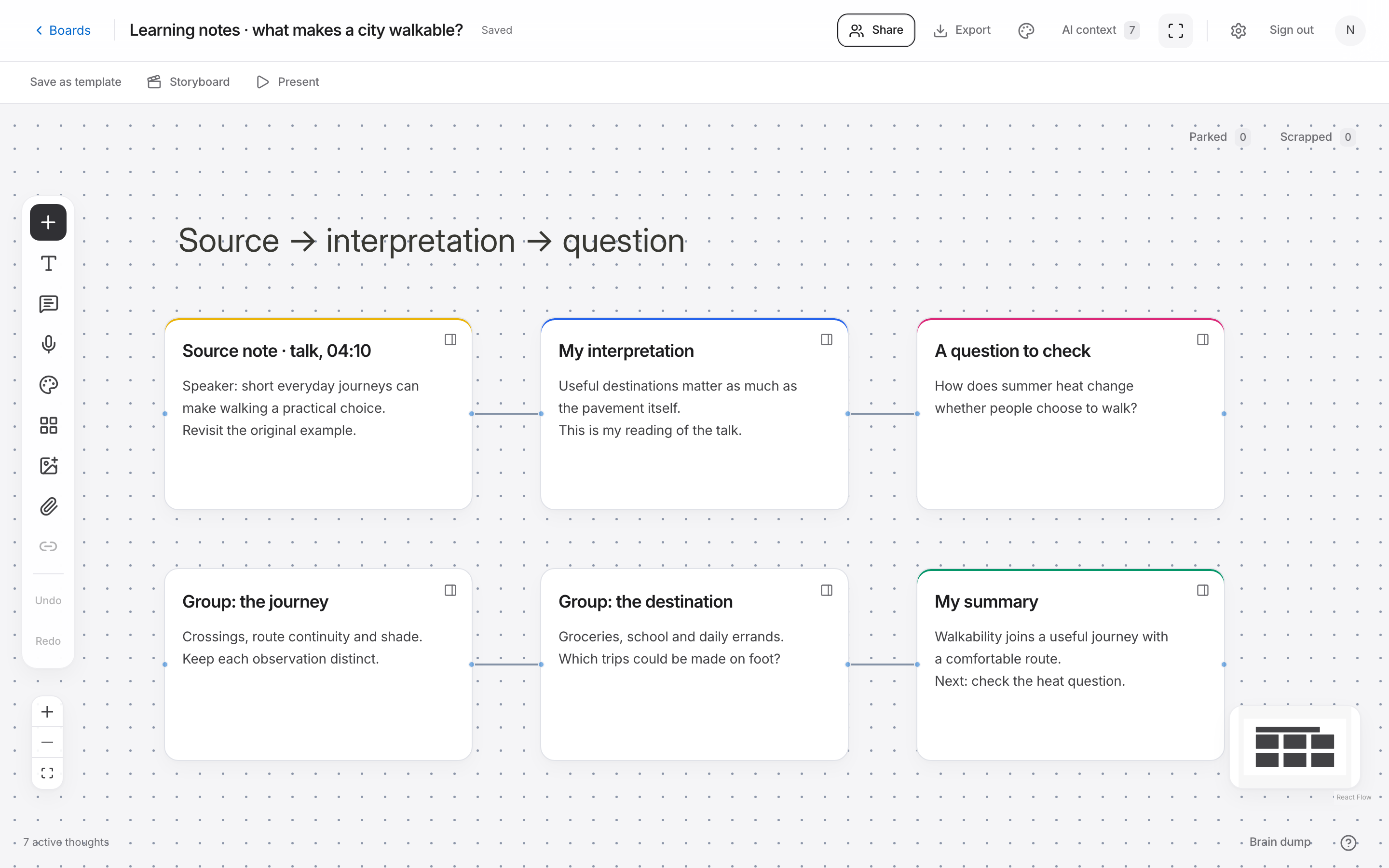
Keep your interpretation in a separate note. “The speaker described three shaded routes” and “shade might explain which route people choose” are different kinds of statement. Putting them next to each other lets you see the connection without making your interpretation look like a finding from the source.
In Noteboard.ai, place a PDF, image, or link beside the notes it supports. Write down the part you need and connect it to your explanation. A file by itself doesn't tell your future self why you saved it.
Example: three notes from one talk
- Source note
- The speaker compares routes with different amounts of shade. Save the talk link and the relevant timestamp.
- My interpretation
- Shade may be one reason someone takes a longer route.
- Question to check
- Did the talk measure route choices, or was this an example the speaker proposed?
3. Group notes around the questions they answer
After capturing, read the notes and choose a few headings. For the walkability example, you might use comfort, safety, and useful destinations. Place a note where it helps explain one of those questions. If it relates to two groups, add a connection rather than rewriting it.
Label a connection when its meaning matters. A note might “supports,” “questions,” or “gives an example of” another note. Those words make you check your reasoning. If you can't explain the link, keep the notes apart until you understand the relationship better.
Leave disagreements visible. Two sources may describe different situations or use the same word differently. Add a question about the difference instead of merging them into one confident summary.
4. Write a short summary before you leave
Use your own words to explain the main idea in two or three sentences. If you can only repeat the labels, revisit the connections. Add one question you still need to answer and mark where to start when you return.
You might write: “These notes suggest that route comfort includes more than distance. I still need to check whether the examples describe observed choices or possible explanations.” That summary tells you what you understand and what remains uncertain.
When you reopen the notes, read the summary first, then follow the connections you need. Add detail when a question requires it. Keeping every note equally prominent makes the board harder to use, so move background material aside as the project develops.
An AI prompt for this workflow
Using only these notes, identify the main explanation, the evidence supporting it, and the questions that remain unanswered.
Do I need to draw to take visual notes?
No. Short text cards, spatial groups, and meaningful connections are enough. Images can help when the reference itself matters, but drawing is optional.
Try this in Noteboard.ai
Start a board with separate text cards for source notes, your interpretations, and open questions. Add groups and connections as the explanation becomes clearer.
Explore Files & embeds