 noteboard
Mind map vs concept map: the main differences
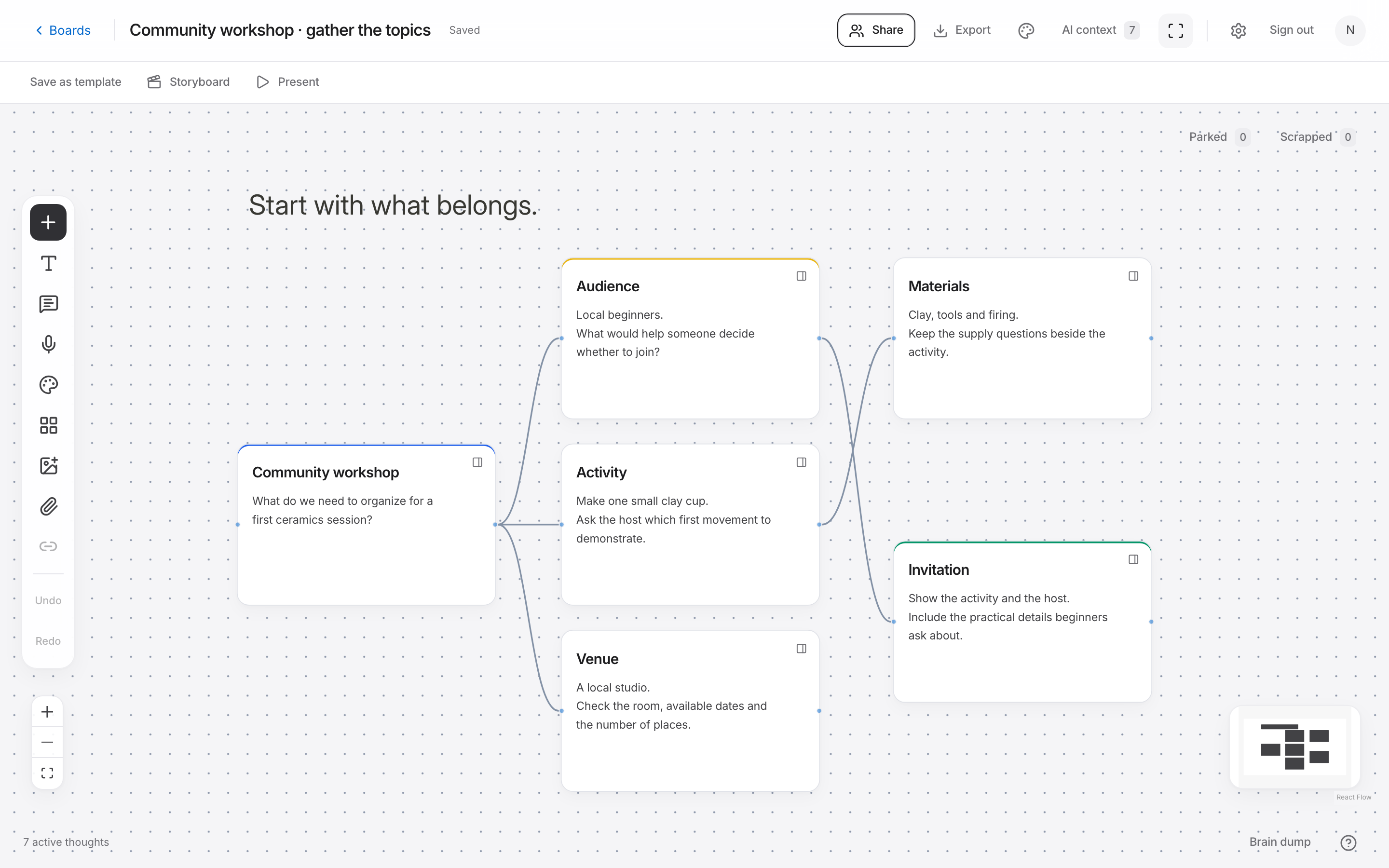
Imagine planning a community ceramics workshop. You need to think about the audience, activity, venue, materials, and invitation. A mind map can collect those subjects around “Workshop” so you can see what needs attention. The lines say that each branch belongs to the topic.
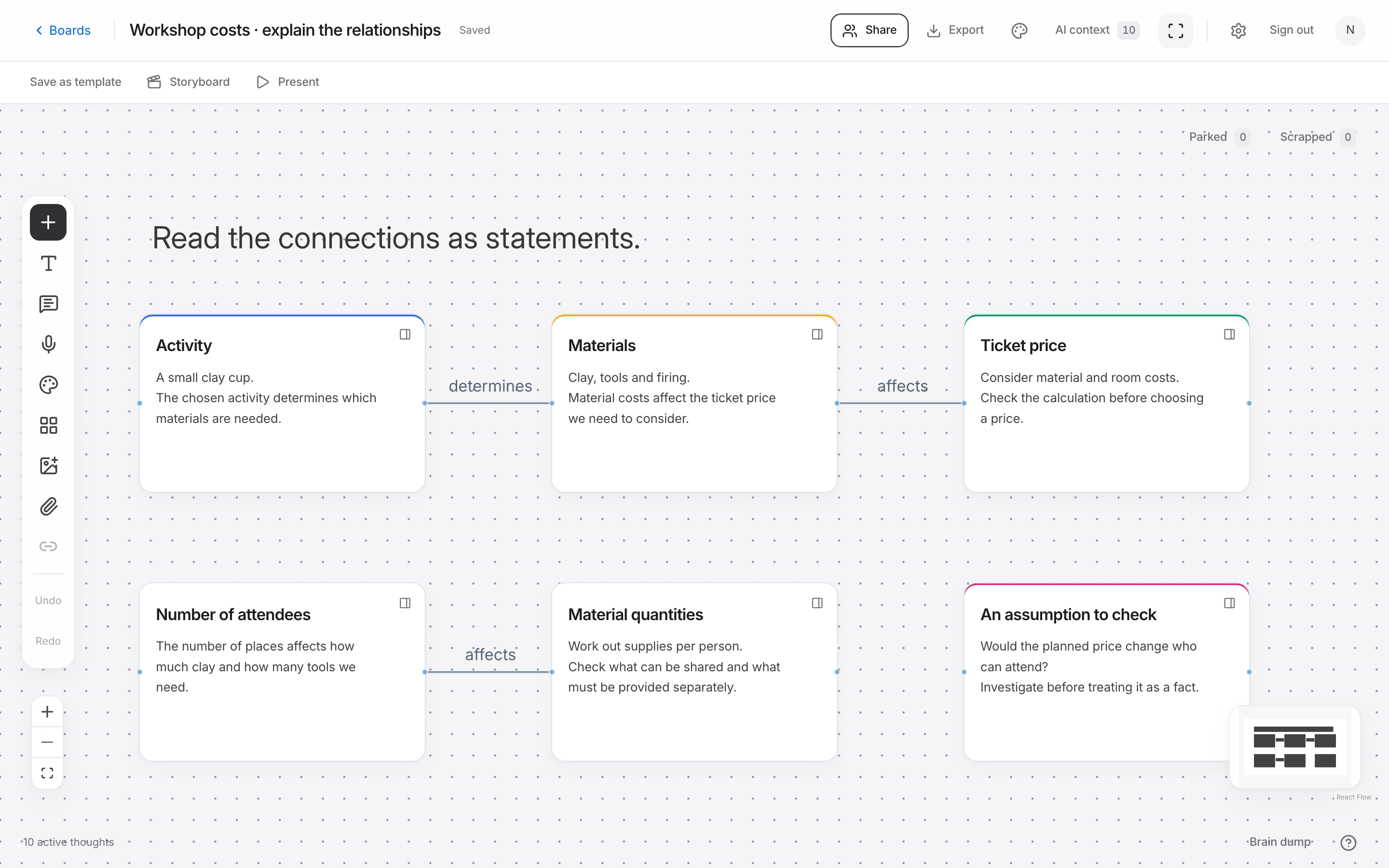
Now suppose you're trying to explain the ticket price. The activity determines which materials you need, and the materials affect the cost. A concept map makes those relationships explicit with words on the connections. You can read a pair of connected notes as a statement.
| Question | Mind map | Concept map |
|---|---|---|
| Where do I start? | Usually with one central topic or question | With a focus question and the concepts needed to explain it |
| How do I organize it? | Branches and smaller groups around the topic | Related concepts arranged as a network or hierarchy |
| What do the lines mean? | These details belong to the same topic or branch | A stated relationship, such as determines, requires, or affects |
| What is it useful for? | Collecting ideas, brainstorming, and exploring an outline | Explaining relationships, dependencies, or an understanding of a subject |
| What should I check? | Have I grouped the main ideas in a useful way? | Can I read each relationship as a clear, accurate statement? |
Use a mind map when you need to gather the topics
Put “Workshop” in the center and add the main branches. Under audience, write what you know about the beginners you want to invite. Under activity, add the object they will make and the questions you need to ask the host. Under venue, add possible locations and practical limits.
You can keep adding material without deciding every dependency yet. A question about the room size can sit beside an answer about the available tools. That makes a mind map useful early in a project, when you want to see what you have considered and what still needs attention.
The branches don't have to be perfect categories. If materials and activity keep overlapping, connect the notes or change the grouping. If you're using the map for writing, the main branches can be arguments, scenes, or research questions. Choose labels that help you work with your own material.
Use a concept map when the relationship is the point
Start with a question such as “What affects the cost of this workshop?” Choose the concepts that help answer it: activity, materials, number of attendees, room cost, and ticket price. Connect two concepts with a phrase that says what you mean.
For example, “activity determines materials” and “number of attendees affects material quantities” explain different parts of the plan. Keep the phrasing precise. If you draw a line from ticket price to attendance, write whether you're describing an assumption to investigate rather than a relationship you've established.
Read each connection aloud. “Materials affect ticket price” is an understandable statement, even if the full pricing calculation needs more detail. “Materials—ticket price” leaves the reader to supply the meaning. This reading check helps you notice where your explanation is incomplete.
Adding a line alone does not make a concept map meaningful. Choose a linking phrase that makes the two concepts read as a clear statement. Add cross-connections when they explain how one part of the subject affects another, and check that someone else can follow or question the relationship.
| Mind map: group the topic | Concept map: state a relationship |
|---|---|
| Workshop → venue, audience, materials | Workshop requires a venue |
| Audience → beginners | A beginner audience influences the instructions |
Choose according to the question you need to answer
If you're asking “What belongs in this project?” begin with a mind map. If you're asking “How do these things affect one another?” a concept map may be more useful. You can use both in the same project without redrawing every note from scratch.
For the workshop, start with branches to collect the planning questions. When a cost question needs attention, take the relevant notes and add labeled connections. After you understand the relationship, return to the wider plan and update the decision it affects.
In Noteboard.ai, use separate editable notes for the ideas and connect them where the relationship matters. A central note and branches give you a mind-map starting structure. Connection labels let you explain a relationship more explicitly. Keep the arrangement understandable to the person who will use it next, including yourself.
Example: the question changes the diagram
- Gathering the plan
- What needs organizing? Use branches for the audience, activity, venue, materials, and invitation.
- Explaining a decision
- Why does this activity cost more? Connect the activity to its materials and the materials to the cost.
- Returning to the plan
- Record the chosen activity and the remaining price question on the project map.
Mind map vs outline: when you need a reading order
An outline puts the material in a sequence: this comes first, this follows, and this supports the point above it. A mind map lets you keep several branches open while you work out what belongs. The practical difference becomes clear when you start drafting or presenting.
For an article about the workshop, your mind map might hold notes about the host, the activity, the audience, and the space. An outline chooses the order a reader needs: introduce the workshop, explain the activity, answer practical questions, then describe how to book. Move from the map to an outline when choosing that order becomes the job.
If the outline keeps breaking, check the map. You may have two pieces trying to share one argument, or a missing explanation between sections. Revisit the relationships before spending more time adjusting the headings.
Use a mind map to collect and group ideas. Use a concept map to explain labeled relationships. Use an outline when you need to put the material in order.